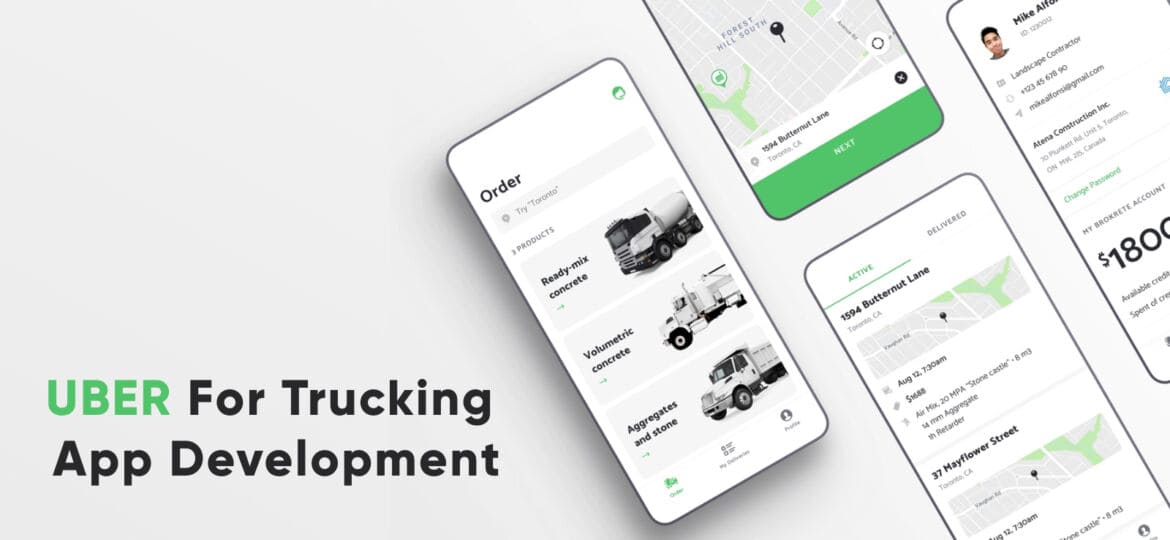
Building an Uber for trucking app — an on-demand freight marketplace that matches shippers with available carriers and tracks loads in real time — varies widely in cost in 2026. The range is wide because a two-sided load board is a modest build, while a full logistics marketplace with dispatch, route optimization, and telematics is a serious platform. This guide from our mobile app development team explains what each tier includes, the features shippers and carriers actually use, the technology behind live freight tracking, how long a first version takes, and how we build it. The tiers below reflect 2026 market complexity — we share a transparent quote after a short scoping call.
Key takeaways
- The cost of an Uber for trucking app varies widely in 2026, depending on whether you build a load board or a full logistics marketplace.
- The core value is load matching: connecting a shipper’s freight with the right available carrier fast, with transparent pricing and live tracking.
- A regional MVP can ship in 4–6 months; a full marketplace with dispatch and telematics runs 8–12 months.
- Real-time GPS tracking, digital documents (BOL/POD), in-app payments, and ELD/telematics integrations are what move it from a prototype to a usable product.
- A 2-week fixed-price pilot sprint scopes the marketplace, validates the matching logic, and returns a transparent quote before you commit a full budget.
In this article
How much does it cost to build an Uber for trucking app?
An Uber for trucking build costs more than a passenger ride-hailing clone because freight adds documents, payments between businesses, and compliance. A regional MVP — shipper and carrier apps, load posting, matching, and basic tracking — generally sits at the entry level of the range. A standard freight platform across iOS, Android, and web, with real-time tracking, digital bills of lading and proof of delivery, in-app payments, and ratings, usually sits in the mid-range. A full logistics marketplace — dispatch, route optimization, ELD and telematics integrations, broker and admin dashboards, and analytics — reaches the top, enterprise-scale tier and climbs with scale. The table below maps the tiers to budget. If your model leans toward last-mile or parcel rather than long-haul freight, our on-demand app development practice can adapt the same marketplace pattern. Treat these as 2026 complexity tiers; we share a transparent, fixed quote after a short scoping call once we understand your freight types, regions, and integration needs. It helps to read these ranges as reflecting complexity rather than quality: two apps can share the same budget and be built to the same standard, yet one is a clean regional load board and the other is stretched thin trying to cover too much. The expensive parts of a freight platform are rarely the visible screens — they are the matching engine, the settlement flows, and the integrations with telematics and regulatory systems that carriers expect. A common and costly mistake is to budget for the app you can see and underfund the plumbing underneath it, then discover mid-build that the marketplace cannot actually move money or verify a driver’s hours. Scoping the invisible parts as carefully as the visible ones is what keeps a freight build on budget, and it is the first thing we do before quoting.
A freight marketplace is one type of logistics platform, and for the broader category it helps to read how to develop a logistics app.
| App tier | What you get | Investment level |
|---|---|---|
| MVP / one region | Shipper + carrier apps, load posting, matching, basic tracking | Entry-level |
| Standard freight platform | iOS + Android + web, real-time tracking, e-docs, in-app payments, ratings | Mid-range |
| Full logistics marketplace | Dispatch, route optimization, ELD/telematics, broker + admin dashboards, analytics | Enterprise-scale |
Must-have features for a freight marketplace
An Uber for trucking app is a two-sided marketplace, so it needs to serve shippers and carriers equally well. On the shipper side, the essentials are load posting with pickup and drop-off details, instant or negotiated pricing, carrier matching and selection, real-time shipment tracking, digital documents, and payment on delivery. On the carrier and driver side, you need load discovery and filtering by lane and equipment type, one-tap booking, turn-by-turn navigation, status updates (accepted, picked up, in transit, delivered), document capture for proof of delivery, and fast settlement. The matching engine is the heart of the product — it pairs freight with the nearest suitable carrier based on equipment, capacity, lane, and rating, and the better it is, the more loads move. Round it out with real-time GPS tracking visible to both sides, in-app messaging, ratings and reviews to build trust, and an admin and dispatch dashboard for oversight, dispute handling, and analytics. Get the matching and tracking right first; everything else supports those two. It also pays to design for the realities of freight: carriers care about deadhead miles, so surfacing backhaul loads near a delivery point keeps trucks earning and keeps them on your platform. Shippers care about reliability, so accurate ETAs, exception alerts when a load is delayed, and clean proof-of-delivery documents matter more than flashy screens. Fast, predictable settlement is often the single biggest reason a carrier chooses one app over another, so treat payments as a core feature rather than an afterthought. Prioritizing the features that keep both sides transacting — good matches, honest tracking, and quick pay — is how a load board becomes a marketplace people rely on rather than one they check occasionally.
For crowdsourced, peer-to-peer models similar to this two-sided marketplace, see our roundup of delivery apps like Roadie.
Tech stack and integrations
Freight platforms live or die on reliability, so the stack favors proven, scalable components. For the apps we generally use Flutter or React Native for shared iOS and Android codebases, with a web dashboard in React for shippers, brokers, and admins. The backend commonly runs on Node.js or Django with PostgreSQL for transactional and load data and Redis for real-time caching. Live tracking uses the Google Maps Platform or Mapbox for maps, geocoding, distance, and ETAs, with WebSockets streaming driver location. The freight-specific integrations are what make it real: ELD and telematics providers (such as Samsara or Motive) for hours-of-service and vehicle data, e-signature and document handling for BOL and POD, and a payments and settlement layer (Stripe or an ACH/factoring partner) for business-to-business transactions. Notifications run through Firebase and Twilio. A route-optimization service reduces empty miles as you scale. If you already have an engineering team, our IT staff augmentation model can add logistics-experienced specialists to it rather than replacing it.
How long does it take to build?
Timelines follow scope. A regional MVP — shipper and carrier apps, load posting, matching, and basic tracking — is realistic in 4 to 6 months. A standard freight platform across iOS, Android, and web, with real-time tracking, digital documents, payments, and ratings, generally takes 6 to 9 months. A full logistics marketplace with dispatch, route optimization, ELD and telematics integrations, and broker and admin dashboards runs 8 to 12 months or more, because third-party integrations and B2B payment flows add testing time. Those estimates assume a dedicated team working in two-week sprints with a usable build early. We front-load the matching engine and live tracking, since those are the pieces the whole marketplace depends on, and we integrate telematics and settlement once the core loop of post, match, move, and pay is solid. Launching in one lane or region first, then expanding, is the most dependable path and lets real carriers and shippers shape the product before you scale.
What drives the cost up or down
A few decisions move the budget more than the rest. The matching and dispatch logic is the biggest: a simple nearest-carrier match is inexpensive, while automated dispatch with route and capacity optimization is a substantial engineering effort. Telematics and ELD integrations add per-provider work and ongoing costs. B2B payments and settlement — factoring, ACH, quick-pay — carry compliance and integration overhead beyond a simple card charge. The number of platforms and roles (shipper, carrier, driver, broker, admin, each on mobile or web) multiplies design and QA. You can bring cost down by launching in one region and one freight type, starting with manual matching before automating it, using a cross-platform framework to share code, and deferring analytics and optimization to a later release. The right sequence protects both the marketplace economics and your budget. Our on-demand app development and mobile app development teams scope exactly this trade-off before a line of code is written.
How does an Uber for trucking app make money?
A freight marketplace has clear, proven revenue models, and most platforms combine a few. The primary stream is a commission or take rate on each booked load, charged to the carrier, the shipper, or split between them — typically a percentage of the freight value. A subscription or membership tier suits high-volume shippers and carriers who want lower per-load fees, priority matching, or advanced analytics, and it gives you predictable recurring revenue. Quick-pay or factoring fees are a strong stream in freight: carriers often pay a small percentage to be paid in hours rather than weeks, and you can offer that as a service. Value-added services — insurance, fuel cards, load insurance, or premium tracking — can be layered in as the platform matures. Some marketplaces also charge listing or lead fees for posting loads. The right blend depends on whether your density is on the shipper or carrier side and how competitive your lanes are, so it is worth modeling the take rate against real freight economics before you build. We help you pick a model that keeps carriers and shippers on the platform rather than routing around it, and we build the billing, settlement, and payout logic to match. Marketplace revenue only works when both sides keep coming back, so pricing and matching quality have to reinforce each other.
How EchoInnovate IT builds an Uber for trucking app
EchoInnovate IT is an India-based custom and white-label software development company with 12 years in the field, a team of 50+, and 500+ products shipped — many launched under our clients’ own brands. We hold a 5.0 rating on Clutch across verified reviews. For an Uber for trucking build we start with the marketplace economics: how loads are priced, how carriers are matched, and how money moves, because those decisions shape every screen. A dedicated team of product, design, mobile, backend, and QA engineers then works in two-week sprints, delivering a testable build early and integrating maps, telematics, documents, and payments as the core loop proves out. We build the shipper, carrier, and admin experiences as one system and, because we work white-label, ship the whole platform under your brand. Whether you need a full product team or specialists added to your own through our software development and mobile app development services, we cover the entire build. The lowest-risk way to start is the fixed-price pilot sprint described below.

Start with a 2-week pilot sprint
Not sure whether you need a simple load board or a full logistics marketplace — or what it will cost? Start with our fixed-price 2-week pilot sprint. In two weeks a dedicated team scopes your Uber for trucking app, validates the load-matching and tracking architecture, and delivers a working proof of concept plus a transparent quote for the full build. It is the lowest-risk way to test the model before you commit budget. Explore our mobile app development services, or book the pilot sprint and we will help you scope and start building this month.
See the service →Book a scoping call →Frequently asked questions
How much does it cost to build an Uber for trucking app?
In 2026, a regional MVP sits at the entry level, a standard freight platform across mobile and web in the mid-range, and a full logistics marketplace with dispatch and telematics at the enterprise scale. The biggest variable is how much matching, optimization, and integration you automate. These are complexity tiers; we share a transparent quote after a scoping call.
What features make an Uber for trucking app work?
The core is a matching engine that pairs freight with the right available carrier by equipment, lane, capacity, and rating. Around it you need load posting, real-time GPS tracking, digital bills of lading and proof of delivery, in-app payments and settlement, ratings, messaging, and an admin or dispatch dashboard. Matching and tracking come first; the rest supports them.
How long does it take to develop a freight marketplace app?
A regional MVP is realistic in 4 to 6 months, a standard platform in 6 to 9 months, and a full logistics marketplace with route optimization and telematics in 8 to 12 months or more. We front-load the matching engine and live tracking because the whole marketplace depends on them, then add integrations once the core loop is proven.
Do I need ELD or telematics integration?
If you serve regulated long-haul freight in the US, integrating ELD and telematics providers (such as Samsara or Motive) adds real value for hours-of-service visibility and accurate tracking, and it is often expected by carriers. For a regional MVP you can start with GPS-only tracking and add telematics as you scale. We help you decide based on your freight types and regions.
Can you build both the mobile apps and the web dashboard?
Yes. We build the shipper and carrier mobile apps for iOS and Android, plus the web dashboards that brokers, dispatchers, and admins rely on, as one connected system. Using a cross-platform framework lets us share most of the mobile code, which keeps a two-platform launch affordable.
Will the platform ship under my brand?
Yes. EchoInnovate IT works white-label, so the entire freight marketplace ships under your brand and your app store accounts. We have delivered 500+ products, many launched under clients’ own brands, and can stay entirely behind the scenes.