Custom Ionic App Development Companies for Future-Ready Ionic Apps
#Ionic Development Services
Next-Gen Ionic App Development Services
Ionic app development lets you ship one web codebase to iOS, Android, and the web at once. At EchoInnovate IT, our Ionic developers build hybrid apps with the open-source Ionic Framework, pairing its 100+ UI components with Angular, React, or Vue. Capacitor then wraps that codebase into native binaries and exposes device APIs like Camera, Geolocation, and Push. The result is a single team, a single language stack, and genuinely native-feeling apps on every platform. We favor Ionic when time-to-market, budget discipline, and shared logic across mobile and mobile app development targets matter more than heavy 3D or game-grade animation.
What is Ionic app development?
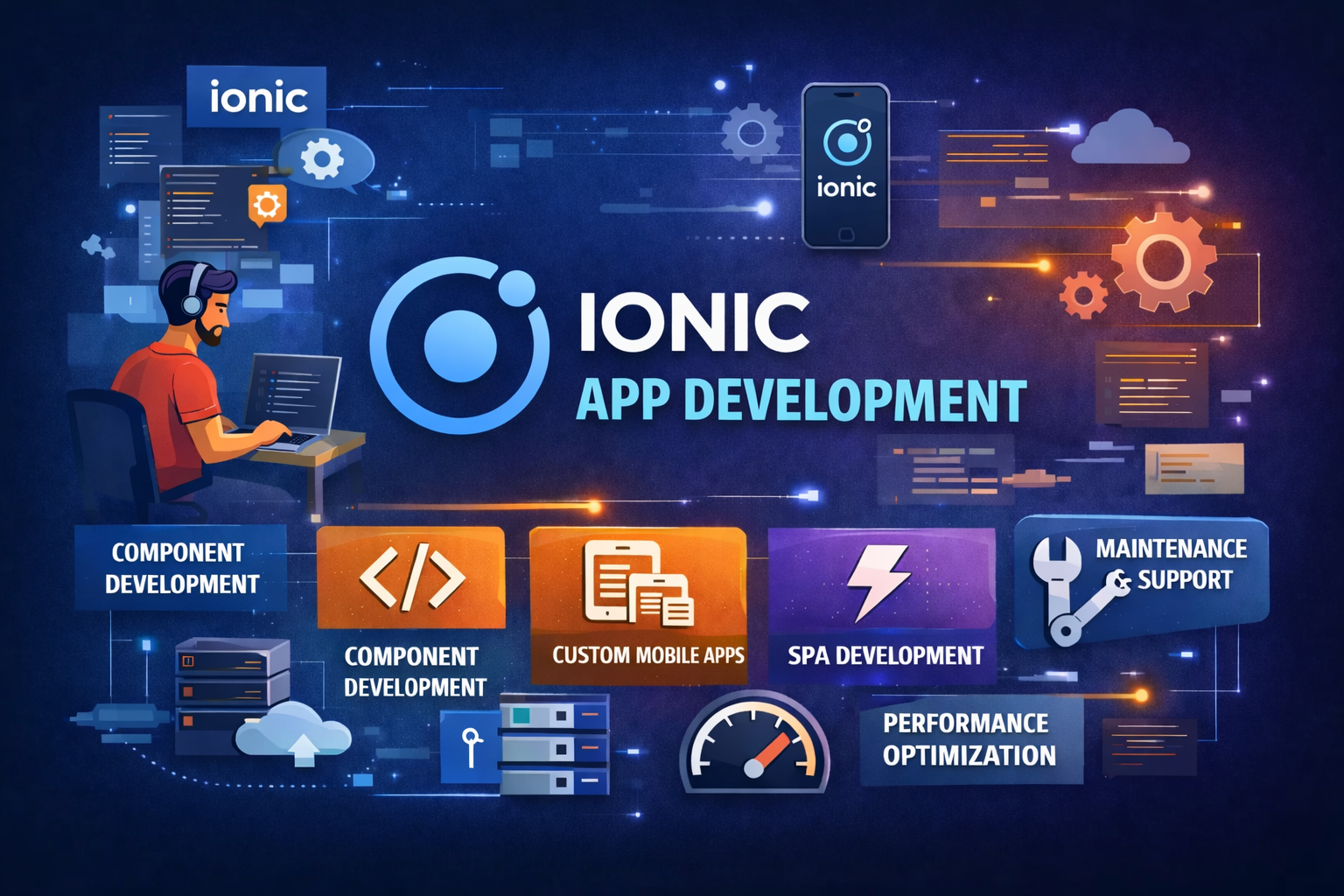
Ionic app development is the building of cross-platform mobile, web, and desktop apps from a single codebase with Ionic — an open-source framework that uses standard web technologies (HTML, CSS, JavaScript) and works with Angular, React, or Vue. It is a core part of our mobile app development services. Need a team? Hire dedicated Ionic developers.
Ionic ships to iOS, Android, web, and desktop from a single codebase.Source: Ionic docs, 2026
built with familiar HTML, CSS, and JavaScript plus Angular, React, or Vue.Source: Ionic, 2026
Full-Spectrum Ionic Solutions Across Industries
We deliver the full Ionic lifecycle: strategy, UI engineering, Capacitor native integration, backend APIs, store deployment, and long-term maintenance. Because Ionic renders through a WebView using standard HTML, CSS, and TypeScript, your web and mobile teams share components, tooling, and tests. We tune startup time, lazy-load routes, and virtualize long lists so hybrid apps stay smooth on mid-tier Android hardware. When a project genuinely needs bare-metal performance, we are candid about React Native or fully native alternatives instead of forcing Ionic where it does not fit.
Ionic App Consultation
Our Ionic consulting experts assess your product vision, target platforms, and existing web assets before a single line is written. We map whether hybrid, React Native, or native best fits your budget, timeline, and performance needs. You leave with a framework recommendation (Angular, React, or Vue), a Capacitor plugin plan, and a realistic delivery estimate grounded in your actual requirements.
Cross-Platform Mobile Apps
Our Ionic developers build one codebase that compiles to native iOS and Android through Capacitor, plus an installable PWA. Shared TypeScript logic, routing, and state management mean features ship once and run everywhere. We use Ionic's platform-adaptive components so the same screens honor iOS and Material Design conventions automatically, cutting duplicate work while preserving a native look on each OS.
Custom UI Components
We craft reusable Ionic UI components with Web Components and your framework of choice, themed through CSS custom properties for instant light and dark modes. Custom cards, modals, gestures, and animations are built on Ionic's Animations API and Gesture utilities for 60fps interactions. Every component is responsive, accessible, and consistent across breakpoints from phone to tablet to desktop web.
Backend & API Integration
Our team wires your Ionic app to secure REST and GraphQL APIs, Firebase, and enterprise backends over HTTPS with token refresh and offline caching. We integrate Capacitor Preferences and SQLite for local persistence so the app stays usable on flaky networks. Real-time features run on WebSockets or Firebase, and we handle auth, rate limiting, and payload optimization to keep the WebView responsive.
Ionic Widget Development
We build lightweight Ionic widgets and micro-interactions that stay smooth inside the WebView on lower-end devices. Using virtual scroll, skeleton loaders, and Ionic's ion-content lazy rendering, list-heavy and dashboard screens paint fast and scroll cleanly. Each widget is packaged as a reusable component so it drops into future screens without rework, keeping your codebase DRY.
Progressive Web Apps (PWAs)
We ship Ionic-powered Progressive Web Apps that install to the home screen, work offline, and re-engage users through push. A service worker and Workbox-based caching serve the app shell instantly, while a web manifest enables standalone launch. The same Ionic codebase that produces your iOS and Android builds also produces the PWA, so one investment reaches app stores and the open web together.
Performance Optimization
Our Ionic performance work targets cold-start time, WebView paint speed, and scroll stability. We lazy-load Angular modules or code-split React routes, tree-shake unused components, and compress assets to shrink bundle size. Profiling with Chrome DevTools and Lighthouse pinpoints jank, so we fix layout thrash and heavy DOM before it reaches users on mid-tier Android phones.
Authentication & Security
We implement OAuth 2.0, JWT, and biometric login via Capacitor plugins, storing tokens in secure device keystores rather than local storage. API traffic runs over TLS with certificate pinning where required, and sensitive data is encrypted at rest with SQLCipher. We follow OWASP MASVS guidance so your Ionic app meets enterprise and app-store security expectations.
Push Notifications & Analytics
We integrate targeted push through Firebase Cloud Messaging and the Capacitor Push Notifications plugin, with deep links that route users to the right screen. Product analytics via Firebase or GA4 track funnels, retention, and feature adoption. This closes the loop between engagement and data, so you can see which notifications actually drive opens and conversions.
App Store & Play Store Deployment
Our deployment team takes your Ionic app from Capacitor build to live listing on the App Store and Google Play. We handle signing, provisioning profiles, adaptive icons, splash screens, and store metadata, plus compliance with Apple and Google review guidelines. We also set up fastlane and CI so future releases ship on a repeatable, one-command pipeline.
Testing & QA
Our QA team validates Ionic apps with unit tests in Jest or Jasmine, end-to-end flows in Cypress, and native-layer checks on real iOS and Android devices. We test across screen sizes, OS versions, and offline states to catch WebView quirks early. Automated regression suites run in CI on every commit, so each release stays stable as the codebase grows.
Support & Maintenance
Our post-launch support keeps your Ionic app current with new iOS and Android releases, Capacitor upgrades, and framework version bumps. We monitor crashes and performance, patch dependencies for security, and ship iterative improvements from real usage data. Clear SLAs and transparent reporting mean you always know the health of your app and what ships next.
Partner with a Trusted Ionic App Development Company
Partner with a results-driven Ionic development company focused on shipping reliable, cost-efficient cross-platform apps. Our approach leans on reusable components, shared TypeScript logic, and Capacitor to cut duplicate engineering across iOS, Android, and web. That efficiency lowers cost and speeds delivery without cutting corners on quality. Whether you need a fresh build or want to hire dedicated Ionic developers, we plug in with clean code standards and honest technical guidance from day one.

Dedicated Ionic Development Services in the USA for Startups & Enterprises for End-to-End Ionic Development Solution
Why Choose Echo for your Iconic App Development?
Strategic Partner for Ionic App Development in India
Choosing the right Ionic partner shapes your product’s trajectory. We build stable, secure, flexible apps that evolve with your business, using the same Angular, React, or Vue skills your web team already trusts. Our developers know when hybrid is the smart call and when a cross-platform developer or fully native route serves you better. That candor, plus deep Angular development experience, means you get architecture decisions made for your outcome, not our convenience.
Cross-Platform Mastery across iOS, Android, and Web
Agile Sprint-Based Execution Model
Clean & Maintainable Code Standards
Flexible Hiring & Engagement Options
UI/UX-Centered Development Approach
Performance Monitoring & Continuous Improvements
Cost-Effective Delivery Without Quality Trade-offs
Business-Driven Development Strategy
Your Trusted Ionic App Development Partner
Connect with our Ionic specialists today and turn your vision into a reliable, user-focused digital product.
Ionic App Development: When Hybrid Is the Right Call
Ionic is the right choice when you want one codebase across iOS, Android, and web without staffing three separate teams. It shines for content-driven apps, dashboards, internal tools, and MVPs where speed and shared logic outweigh raw graphics horsepower. Below we answer the questions clients ask most before committing to a hybrid build.
Is Ionic still relevant with Capacitor?
Yes. Capacitor is now Ionic's official native runtime, replacing the older Cordova model. It gives you a modern plugin API for Camera, Filesystem, Geolocation, and Push, plus first-class access to native iOS and Android projects when you need custom code. You write your UI once in Angular, React, or Vue, and Capacitor compiles it into real App Store and Play Store binaries. This combination keeps Ionic firmly current for 2026 hybrid development.
Ionic vs React Native: which should you pick?
Choose Ionic when your team already writes web code and your app is UI- and data-heavy rather than animation-heavy. Ionic renders in a WebView, so a web developer is instantly productive and the same components run as a PWA. Choose React Native when you need native rendering for complex gestures, heavy lists, or graphics-intensive screens. We evaluate both honestly against your requirements rather than defaulting to one, and a cross-platform developer on our team can prototype either.
Which framework works best with Ionic?
Ionic officially supports Angular, React, and Vue. Angular remains the most common pairing for enterprise apps thanks to its structure, dependency injection, and mature tooling, which is why our Angular development experience matters here. React suits teams already invested in the React ecosystem, and Vue fits smaller apps that value a gentle learning curve. We recommend the framework your team can maintain, not just the one that demos well.
How do we keep hybrid apps performant?
Performance is about disciplined engineering, not the framework alone. We lazy-load routes, virtualize long lists with Ionic's virtual scroll, and code-split bundles so the first paint stays fast. We minimize DOM depth, defer non-critical work, and profile with Lighthouse and Chrome DevTools on real mid-tier Android hardware. For teams scaling up, we also help you hire dedicated Ionic developers who carry these practices into every sprint.
Frequently Asked Questions
Yes, Ionic is a great choice for both startups and enterprises. For startups, it helps launch MVPs quickly and within budget, making it easier to test ideas and enter the market faster. For established businesses, Ionic supports secure, high-performing cross-platform applications that can grow alongside evolving business needs.
The cost of Ionic app development depends on app complexity, features, UI/UX requirements, third-party integrations, and backend infrastructure. A basic app may cost less $8,000+ while enterprise-level applications with advanced functionality require higher investment may range around $80,000+. Hourly rates typically range from $18 to $60 per hour, depending on developer expertise and location. Most Ionic development companies offer flexible pricing models like fixed cost, hourly, or dedicated team engagement.
Ionic application development timelines vary based on scope and complexity. A simple MVP can take about 4 to 8 weeks, while feature-rich or enterprise-grade applications may require around 3 to 6 months or more. Proper planning, clear requirements, and agile methodology significantly impact delivery speed.