
Key takeaways
- A patient-facing hospital app is an entry-level build that ships in 4–6 months; a full patient + staff + admin platform is an enterprise-scale investment over 8–14 months.
- A hospital mobile app spans three roles — patients, clinicians and staff, and administrators — and each role adds real scope.
- EHR/EMR integration (HL7, FHIR) and compliance (HIPAA in the US, and local equivalents) are the biggest cost and timeline drivers.
- Most 2026 builds are cross-platform (React Native or Flutter) with a secure cloud backend and audited integrations.
- Scope drives price, so we quote after a short scoping call. A 2-week pilot sprint is the lowest-risk way to start.
How much does a hospital mobile app cost in 2026?
Hospital app costs vary widely because a simple appointment app and a hospital-wide clinical platform share almost nothing under the hood. What they do share is that healthcare data is regulated and safety-critical, which raises the floor compared with an ordinary consumer app. The table below shows realistic 2026 market ranges by scope, drawn from typical healthcare engagements across offshore and blended teams. Use it to size your budget before a detailed scope, then confirm with a short scoping call.
| Scope | Investment level | Timeline |
|---|---|---|
| Patient app (booking, reminders, basic records) | Entry-level | 4 – 6 months |
| Patient app + telemedicine + payments | Mid-range | 6 – 9 months |
| Multi-role platform + EHR integration | High-end | 8 – 14 months |
| Enterprise hospital system (multi-site, analytics) | Enterprise-scale | 12 – 24 months |
Two factors move these ranges more than anything else. The first is integration: the moment your app must read and write to an electronic health record system, you inherit interface work, data mapping, and testing against a live clinical system that a standalone app never touches. The second is compliance. Healthcare data carries strict privacy and security obligations, and meeting them adds design, tooling, and audit time. Offshore and blended delivery, which is how most of these budgets are built, keeps blended rates well below onshore-only teams for comparable engineering quality, which is a large part of why health-tech teams build with dedicated offshore partners. We do not publish fixed EchoInnovate prices because the same feature list can cost very differently once integration and compliance scope is understood; we provide a transparent quote after a short scoping call. To scale engineering during peak build phases, many teams combine a core squad with IT staff augmentation.
The three roles a hospital app serves
The mistake that inflates most hospital app budgets is treating the product as a single patient app when it is really three connected experiences. Deciding early which roles you are building for is the fastest way to control scope, because each role carries its own features, its own compliance surface, and its own back office.
Patients. The patient app is the visible face of the product. It handles registration, appointment booking and rescheduling, reminders, access to records and test results, prescription refills, secure messaging with providers, telemedicine visits, and payments. Because patients range from young and tech-fluent to elderly and cautious, accessibility and clarity matter as much as features here.
Clinicians and staff. Doctors, nurses, and support staff need a very different app: today’s schedule and patient list, access to charts and history, the ability to place orders and write notes, secure team messaging, and alerts for critical results. This role is where an app either saves clinical time or wastes it, so real workflow input from staff is essential and often underestimated.
Administrators. Behind both apps sits an admin layer for user and role management, scheduling and resource allocation, billing oversight, reporting and analytics, and audit logs that prove who accessed what and when. Teams frequently underestimate this back office, yet it is what makes the system operable, auditable, and safe.
Because these three roles connect to the same records and each other, a hospital mobile app is closer to custom mobile app development with deep integration than to a simple standalone consumer app, and scoping it role by role keeps the estimate honest.
Core features by role
Here is the feature spine most hospital mobile apps share, grouped by the role it serves. Scoping each item honestly, rather than assuming it is a checkbox, is how you avoid the mid-project surprises that inflate healthcare budgets. For a fuller catalogue of options, our companion piece on the best features for hospital app development goes wider on feature choices.
Patient features. Secure sign-up and identity verification; appointment booking, rescheduling, and cancellation; automated reminders by push, SMS, or email; access to medical records, lab results, and imaging; prescription requests and refill tracking; secure messaging with the care team; video consultations; and in-app payments or insurance details. A clear onboarding and a readable records view do more for adoption than any single advanced feature.
Clinician and staff features. A daily schedule and patient roster; access to charts, history, allergies, and medications; order entry for tests and prescriptions; clinical notes and documentation; secure intra-team messaging; and prioritized alerts for critical results or deteriorating patients. Every one of these must be fast, because clinicians work in seconds, not minutes.
Admin features. User and role management with granular permissions; staff scheduling and resource allocation; billing and claims oversight; analytics dashboards for utilization, wait times, and outcomes; content and notification management; and comprehensive audit logging. The audit trail is not optional in healthcare; it is a regulatory requirement and a safety tool.
Shared infrastructure. Single sign-on and strong authentication, role-based access control, encrypted data at rest and in transit, offline-tolerant behavior for poor-connectivity areas, and reliable push notifications underpin all three roles.
EHR integration and the tech stack
For a hospital app, integration is the project. The app is only useful if it reflects the same data clinicians and administrators already work with, which means connecting to the hospital’s electronic health record (EHR/EMR) and often to lab, imaging, pharmacy, and billing systems too.
EHR/EMR integration. Most integration in 2026 uses healthcare interoperability standards: HL7 v2 for legacy messaging and FHIR for modern, resource-based APIs. Major systems such as Epic and Cerner expose FHIR-based interfaces, and your app reads and writes through them rather than storing a separate copy of the record. This work involves data mapping, careful handling of edge cases, and testing against a sandbox before touching live data. It is the single largest technical line item in most hospital app budgets.
Device and service integrations. Depending on scope you may connect to lab information systems, PACS for imaging, e-prescribing networks, payment and insurance clearinghouses, identity providers, and, increasingly, wearables and remote-monitoring devices that stream vitals into the record.
Mobile client. Most hospital apps are built cross-platform with React Native or Flutter so one team ships iOS and Android from a single codebase, which controls cost and keeps the patient and staff apps consistent. Native modules are added where hardware or performance demands them.
Backend and cloud. A secure cloud backend (commonly Node.js or a JVM stack) handles accounts, business logic, integration orchestration, and notifications, hosted on infrastructure that supports healthcare compliance such as HIPAA-eligible AWS, Azure, or Google Cloud services with signed agreements. To add vetted healthcare and mobile engineers quickly during the build, teams often use our IT staff augmentation services, and for the overall program our custom software development team owns architecture and delivery end to end.
Compliance and security
In healthcare, compliance and security are not a phase at the end; they shape the architecture from the first sprint. Which rules apply depends on where you operate, but the engineering principles are consistent.
Regulatory frameworks. In the United States, HIPAA governs how protected health information is stored, transmitted, and accessed, and it requires signed business-associate agreements with any vendor or cloud provider that touches that data. In the European Union, GDPR applies, and many countries have their own health-data laws. Your app must be designed to satisfy the frameworks of every market you serve, and that scope should be fixed at the very start.
Security by design. That means encryption of data at rest and in transit, strong authentication and role-based access control so each user sees only what their role permits, complete audit logging of every access to a record, secure session handling, and safe local storage on the device. Penetration testing and a formal security review are core deliverables, not optional extras.
Operational safeguards. Beyond code, a compliant hospital app needs data-retention and breach-response policies, staff access reviews, and monitoring. These operational elements are part of the true cost of running a healthcare product and should be planned for, not discovered after launch. Getting this right protects patients, protects the hospital, and protects the product itself, because a single breach can end trust in the system overnight.
Timeline and what drives cost
Timeline tracks scope closely. A patient app reaches the store in four to six months, a patient app with telemedicine and payments in six to nine, and a full multi-role platform with EHR integration in eight to fourteen months or more. It helps to think in phases, each with a clear deliverable you can review before committing to the next.
Discovery and scoping (2–4 weeks): requirements, role definitions, compliance mapping, integration assessment against the target EHR, architecture, and a detailed estimate. A pilot sprint fits here.
Design (4–8 weeks): user flows and UI for each role, with heavy input from clinicians and patients so the app fits real workflows.
Core build (3–7 months): the apps, the backend, and the integration layer, built in two-week sprints so you see working software early.
Integration and compliance (4–8 weeks): live EHR connection, security review, and penetration testing.
Testing and launch (3–6 weeks): clinical validation, QA, store submission, and a staged rollout, followed by ongoing maintenance.
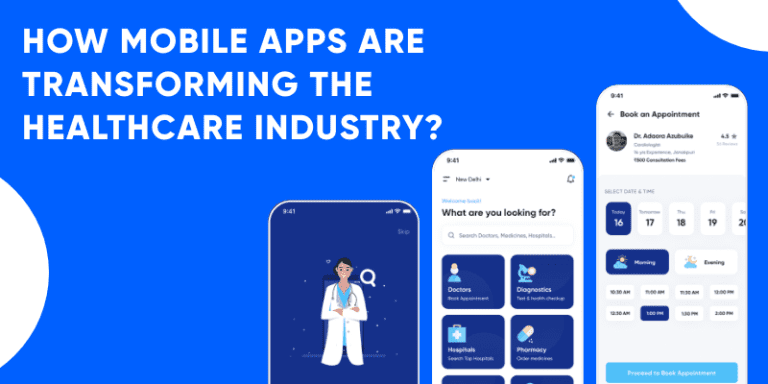
The levers that move cost and time most are the number of user roles you support, the depth of EHR and third-party integration, the compliance frameworks in scope, whether telemedicine and real-time features are included, and your team model. Onshore-only teams cost the most; blended and offshore dedicated teams deliver comparable quality at lower blended rates, which is how most healthcare budgets are built. Our overview of how healthcare mobile apps are transforming care gives useful context on where the value lands.
How EchoInnovate IT builds hospital apps
EchoInnovate IT is an India-based custom and white-label software development company with 12 years of delivery behind us, a team of 50+ employees, and more than 500 products shipped, most of them under our clients’ own brands. We hold a 5.0 rating across 6 verified client reviews on Clutch. For hospital and healthcare work we assemble a dedicated team, typically a mobile lead, backend and integration engineers, a designer with healthcare experience, and a QA engineer, and we run in two-week sprints so you see working software throughout.
Our approach is integration-first and compliance-first, because in healthcare those two decisions shape everything else. We start by mapping the roles, the target EHR, and the regulatory frameworks in scope, then design each role’s experience around real clinical and patient workflows rather than assumptions. We treat security review and penetration testing as core deliverables, and we are candid when a feature adds risk or compliance burden that outweighs its value. Because we work as a white-label partner, the product ships under your hospital’s or company’s brand.
Whether you need a full multi-role platform, a patient app to start with, or extra engineering capacity through dedicated teams and mobile app development, we scope transparently and quote after understanding your real requirements. You are ultimately hiring a team and a process, and in healthcare that team’s discipline around data, integration, and safety is what keeps the product trustworthy long after launch.