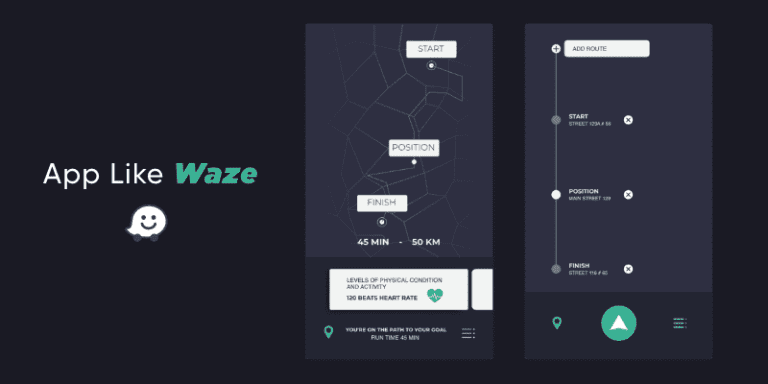
A navigation app like Waze in 2026 ranges from an entry-level MVP to an enterprise-scale platform, with cost driven by scope. A focused MVP with maps, turn-by-turn routing, and search sits at the entry level; a growth build with live traffic, community reports, and voice guidance is a mid-range investment; and a scale platform with predictive ETAs, ridesharing hooks, and offline maps is an enterprise-scale effort. The final figure depends on features, mapping-data licensing, platforms, and the team you hire, so we give a transparent quote after a short scoping call rather than a fixed price. This guide breaks down every cost driver.
EchoInnovate IT is an India-based custom and white-label development shop with 12 years of experience, 50+ employees, 500+ products shipped, and a 5.0 rating across 6 verified Clutch reviews. We build location and mapping apps like this under our own name and under our clients’ brands. Explore our mobile app development services to see how we deliver.
Key takeaways
- A navigation app like Waze spans a wide range in 2026, from an entry-level MVP to an enterprise-scale platform.
- Mapping-data licensing (Google Maps, Mapbox, or open data) is a major, ongoing cost that most guides overlook.
- Cost is driven by real-time traffic, routing, community reporting, voice guidance, offline maps, and platform count.
- A typical MVP takes 4-6 months; a full community-driven navigation app takes 8-12 months.
- Start with a $1,500 fixed-price 2-week pilot sprint to validate scope and get a firm quote before committing budget.
How much does it cost to build a navigation app like Waze?
Cost scales with scope, and a navigation app has an extra dimension most apps do not: mapping and traffic data, which carry licensing fees that continue after launch. A basic routing app is very different from a community-driven platform like Waze, where millions of users report hazards, police, and jams in real time. Below are the three tiers we most often scope. These are relative guides, not quotes; your real number comes after a short scoping call.
| Tier | What you get | Investment level |
|---|---|---|
| MVP | iOS + Android, interactive maps, place search, turn-by-turn routing, basic ETA, user accounts, admin panel | Entry-level |
| Growth | Everything in MVP plus live traffic, community hazard and incident reports, voice-guided navigation, rerouting, saved places, push alerts | Mid-range |
| Scale | Everything in Growth plus predictive ETAs and machine-learning routing, offline maps, carpool or rideshare hooks, gamification, multi-region and advanced analytics | Enterprise-scale |
Most founders launch an MVP, build a user base whose reports make the maps smarter, then reinvest in the Growth features that community data enables. That staged approach keeps the initial budget defensible. See our detailed mobile app development cost guide for a wider breakdown.
What makes an app like Waze
Waze is a community-driven navigation app. What sets it apart from a plain map is that its routing is powered by its users: drivers passively share speed and location, and actively report accidents, hazards, police, and road closures. The app fuses that live crowd data with map data to pick the genuinely fastest route right now, not just the shortest on paper, and it reroutes on the fly as conditions change.
When founders ask us to build “an app like Waze,” they usually want that same loop: reliable maps and routing, live traffic, and a community layer that keeps the data fresh. The complexity that sets a navigation app apart is the real-time data pipeline, the routing engine, and the mapping-data licensing underneath it all. Deciding how much of that community and real-time layer you need at launch is the biggest lever on your budget, and it is exactly what a scoping call resolves.
For routing inside airports, malls, or large venues where GPS struggles, the approach is different, as we explain in our guide to indoor navigation app development.
Must-have features for a navigation app
A navigation app succeeds on accuracy, real-time responsiveness, and safety while driving. These are the features we consider non-negotiable for a credible launch, grouped by core navigation, community, and the platform layer.
Core navigation:
- Interactive maps with smooth pan, zoom, and current location
- Place and address search with autocomplete and points of interest
- Turn-by-turn routing with clear, hands-free voice guidance
- Accurate ETAs and automatic rerouting when conditions change
- Saved places (home, work) and recent destinations
Community and real-time:
- Live traffic overlays from aggregated user data
- One-tap incident reports (accidents, hazards, closures, speed traps)
- Alerts for reports on your route
- Lightweight profiles, points, or badges to encourage reporting
Platform and operations:
- Admin panel for moderation, map corrections, and user management
- Push notifications for traffic and trip reminders
- Analytics on routes, reports, and engagement
- Battery- and data-efficient background location handling
Ship reliable maps, search, and voice-guided routing first. Community reporting and predictive routing are Growth and Scale investments that get better as your user base grows. Our mobile app development team helps you sequence this so you launch sooner and spend smarter.
Tech stack and mapping data
The biggest architectural decision in a navigation app is where the map and routing data come from, because it affects both build cost and ongoing bills. The main options are:
- Google Maps Platform: the richest data and easiest start, billed per API call for maps, directions, and places. Great for speed to market; costs scale with usage, so model this carefully.
- Mapbox: highly customizable maps and navigation SDKs with usage-based pricing, popular for branded, design-led apps.
- OpenStreetMap with a self-hosted routing engine (such as Valhalla, OSRM, or GraphHopper): no per-call license fees, but you run and maintain the infrastructure, which shifts cost from licensing to engineering and hosting.
Around that, a common stack is React Native or Flutter for the apps, a Node.js or Go backend for the real-time reporting pipeline, PostgreSQL with PostGIS for geospatial queries, and a streaming layer (such as Kafka or managed pub/sub) plus Redis to process live reports at scale. Choosing a cross-platform mobile stack is one of the biggest cost decisions; our React Native vs Flutter comparison explains the trade-offs, and React Native app development is one of our core services.
How long does it take to build?
Timeline tracks scope closely. As a rule of thumb:
- MVP (4-6 months): discovery and design, then maps, search, turn-by-turn routing with voice, ETAs, and an admin panel across iOS and Android.
- Growth build (7-9 months): add live traffic, community reporting and moderation, rerouting, alerts, and gamification.
- Scale platform (9-12 months+): add predictive ML routing, offline maps, rideshare or carpool features, and multi-region support, usually phased after launch.
A dedicated team of six to eight, two mobile engineers with strong maps experience, one or two backend engineers for the real-time pipeline, a designer, a QA engineer, and a project lead, is a typical shape for this build. Navigation needs heavy real-world testing across devices and driving conditions, so budget serious QA time. Working in two-week sprints, you see a usable map early and steer with real feedback. If you need specialists mid-project, our IT staff augmentation services let you scale the team up or down without long hiring cycles.
What drives the cost
Six factors move the budget more than anything else:
- Mapping-data source and licensing. Google Maps and Mapbox are fast to integrate but bill per use, so heavy traffic means ongoing cost; self-hosted OpenStreetMap routing removes license fees but adds engineering and hosting.
- Real-time data pipeline. Ingesting, aggregating, and serving millions of live location and report events is significant backend work.
- Routing intelligence. Basic shortest-path routing is affordable; traffic-aware and predictive ML routing is a much larger investment.
- Community and moderation. User reporting needs anti-abuse safeguards and moderation to stay trustworthy.
- Number of platforms and device testing. iOS, Android, background location, and battery efficiency all need building and real-world testing.
- Team location and model. Onshore rates can be several times offshore rates for comparable quality, which is why most cost-conscious founders build with an offshore dedicated team.
The biggest savings lever is team model. Our guide to offshore software development rates by country shows how much location affects the bill, and how to hire offshore developers covers doing it without quality risk.
How navigation apps make money
Revenue design should shape the build, so plan it early. The proven models for a navigation app are:
- Location-based advertising: sponsored pins and offers from nearby businesses, the model Waze itself uses.
- Freemium subscriptions: a paid tier for offline maps, ad-free navigation, or advanced routing.
- B2B and fleet licensing: selling navigation and routing as an SDK or service to logistics, delivery, and fleet operators, often the most lucrative path.
- Data insights (anonymized and privacy-compliant): aggregated traffic-pattern insights for planners and businesses, handled carefully within privacy law.
- Partnerships: integrations with rideshare, EV charging, parking, or fuel networks.
Many navigation startups find B2B fleet and SDK licensing more sustainable than consumer advertising, which needs enormous scale to pay off. Deciding your primary model up front determines which features are revenue-critical and keeps the first build focused on what pays back.
How EchoInnovate IT builds navigation apps
EchoInnovate IT is an India-based custom and white-label software development company with 12 years in business, 50+ employees, and 500+ products shipped, most of them under our clients’ own brands. We hold a 5.0 rating across 6 verified Clutch reviews. For a location product like a navigation app, we assign a dedicated team, work in transparent two-week sprints, and start with a discovery phase that turns your idea into a scoped, priced plan, including the mapping-data decision that shapes ongoing cost, before any production code is written.
We build cross-platform to control your cost, engineer the real-time routing and reporting pipeline for reliability, handle the app-store releases, and stay on for maintenance after launch. Because so much of our work is white-label, you own the product and the brand; we are the engineering team behind it. Whether you need a full build or extra hands, our mobile app development and software development company services cover the entire lifecycle, and you can add specialists any time through IT staff augmentation.