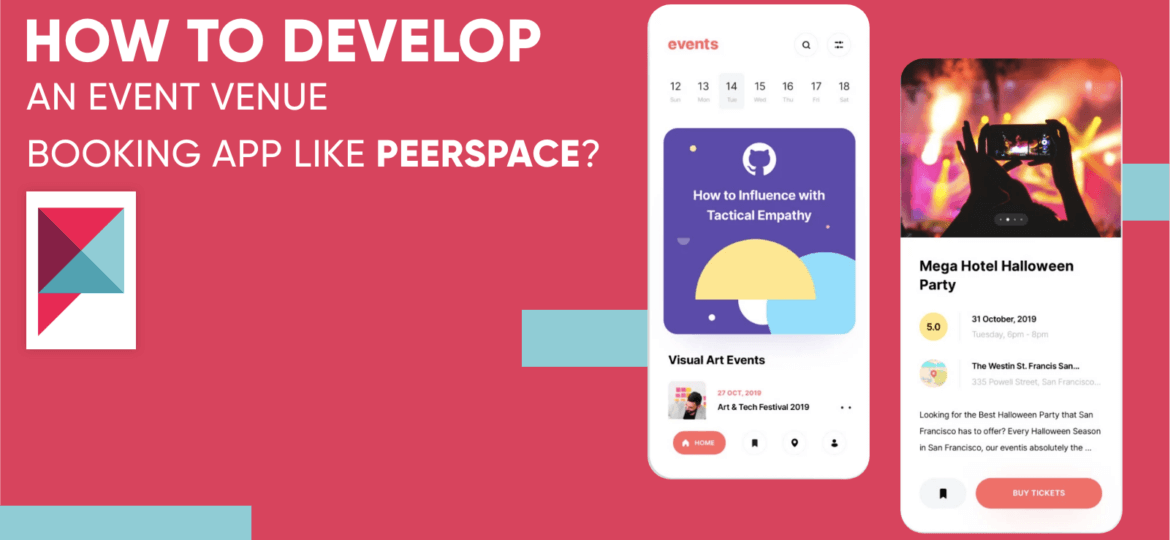
A venue and space booking app like Peerspace is a significant investment to build in 2026. Peerspace is a two-sided marketplace—hosts list spaces, guests search and book them by the hour—and that structure, not the pretty listing screens, is what sets the price. A lean marketplace MVP with listings, search, booking, and payments sits at the entry level; a full platform with host and guest apps, calendar sync, in-app messaging, reviews, and dynamic pricing sits at the high end. Most funded startups plan a substantial budget for a credible first release across both app stores.
This guide answers what buyers actually ask before committing budget: what a Peerspace-style app involves in 2026, which features are essential, the tech stack and integrations behind a booking marketplace, how long the build takes, and what pushes the price up or down. EchoInnovate IT has shipped 500+ products over 12 years—most under our clients’ own brands—so the guidance below reflects real mobile app development projects.
Key takeaways
- Investment scales with scope: a marketplace MVP sits at the entry level, a two-sided host/guest app in the mid-range, and a full platform at enterprise scale.
- The cost lives in the marketplace mechanics—search, availability calendars, booking logic, split payments, and trust/safety—not the listing UI.
- You are building two products at once: a host experience and a guest experience, plus an admin to run both.
- Timeline runs 12–18 weeks for an MVP and 5–14 months for a full platform.
- We do not publish fixed prices because scope decides everything; you get a transparent quote after a short scoping call, or a fixed-price 2-week pilot sprint to price it precisely.
How much does it cost to build a venue booking app?
The honest answer is that it varies, because a Peerspace-style app can be a single-city MVP or a national two-sided platform. The table below breaks the 2026 market into three realistic tiers so you can locate your project before asking for a quote. These are relative investment levels for custom marketplace builds, not fixed prices—your real number depends on the scope we agree together.
| Tier | What you get | Investment level | Timeline |
|---|---|---|---|
| Marketplace MVP | Listings, search & filters, availability, booking, online payments, single platform | Entry-level | 12–18 weeks |
| Two-sided host + guest app | Separate host/guest flows, calendar sync, messaging, reviews, split payments, both platforms | Mid-range | 5–8 months |
| Full booking platform | Dynamic pricing, ID verification, insurance, maps, admin analytics, scale | Enterprise-scale | 8–14+ months |
The jump between tiers is driven by two things: whether you build both host and guest experiences on day one, and how much trust-and-safety machinery you add (ID verification, secure payouts, cancellation and refund logic, insurance). If your goal is to prove that hosts will list and guests will book in one market, start at the MVP tier and expand from traction. Our mobile app development cost guide details the line items, and our mobile app development team will map your feature list to a tier on a scoping call.
Must-have features of a Peerspace-like app
A booking marketplace only works when both sides trust it, so the feature set spans discovery, transaction, and safety. Build the wrong subset and either hosts do not list or guests do not book. Here is what matters, grouped by who it serves.
For guests: discovery and booking. Map and list search with filters (location, capacity, price, amenities, activity type), rich listing pages with photo galleries, real-time availability, instant or request-to-book flows, and secure checkout. Search quality and trustworthy availability are what turn browsing into bookings.
For hosts: listing and management. Guided listing creation, calendar and pricing management, availability blocking, booking approval, and payout tracking. If hosting is painful, supply dries up—so the host tools deserve as much care as the guest app.
Shared: trust and communication. In-app messaging between host and guest, reviews and ratings on both sides, notifications, and a clear cancellation and refund policy enforced in software. These are the mechanics that make strangers comfortable transacting.
Payments and payouts. Secure guest payments, marketplace split payments with platform commission, host payouts, security deposits, and refunds. This is genuinely complex—a payments provider with marketplace/Connect features (such as Stripe Connect) usually handles the hardest parts.
Safety and scale. Phone and ID verification, optional insurance, dispute handling, and an admin console to moderate listings, resolve issues, and read analytics. If your platform touches regulated payments or data, our software development company team aligns the build with the relevant compliance regime.
Tech stack and integrations
A booking marketplace is an integration-heavy product, so the stack shapes both cost and how quickly you can scale supply and demand. There is no single right answer, but there are proven paths. Below is the shape of a modern 2026 build and the pieces that do the heavy lifting.
Client apps. A cross-platform framework such as Flutter or React Native lets one team ship host and guest experiences for iOS and Android from a shared codebase—usually the most cost-effective route for a marketplace with several surfaces. See our React Native vs Flutter comparison for how that choice affects cost and hiring.
Backend and data. A scalable API layer, a well-modelled database for listings, availability, and bookings, and—critically—a booking engine that prevents double-bookings under concurrency. A search service (such as Elasticsearch or Algolia) powers fast, filtered discovery as the catalog grows.
Payments. A marketplace-capable provider like Stripe Connect for guest charges, platform commission, host payouts, deposits, and refunds. This removes an enormous amount of financial and compliance risk versus rolling your own.
Maps and location. Google Maps or Mapbox for map search, geocoding, and directions—central to a space-booking experience.
Supporting services. Push notifications via APNs and FCM, an in-app messaging/chat layer, ID verification, media storage behind a CDN, email, and analytics. If you need to scale the team to build host and guest apps in parallel, IT staff augmentation lets you add vetted engineers without long hiring cycles. Many marketplaces also add a responsive web app so listings are indexable and bookable in the browser.
How long does it take to build?
A realistic first release of a Peerspace-style app takes between three months and over a year, and the timeline depends on how much of the two-sided platform you build up front. Trying to ship host apps, guest apps, and full trust-and-safety at once is the most common way these projects stall.
A marketplace MVP—listings, search, availability, booking, payments on one platform—is achievable in 12 to 18 weeks. That window covers discovery and design, the listing and search experience, the booking engine, payments, and enough testing to launch in one market. A two-sided host + guest app with calendar sync, messaging, reviews, and split payments across both platforms typically runs five to eight months. A full platform with dynamic pricing, ID verification, insurance, and scale is an eight-to-fourteen-month-plus commitment that keeps evolving after launch.
The reliable way to protect the date is to sequence the build: launch the guest booking experience and a manageable host onboarding first, prove liquidity in one city, then expand features and geography on a stable base. A dedicated team working in two-week sprints gives you a shippable increment every fortnight, so the launch is something you manage rather than hope for.
What drives the cost up or down
When two quotes for “an app like Peerspace” differ by six figures, it is almost never the listing screens. These are the factors that actually move the number, and understanding them lets you control the budget.
One side or two on day one. Building both a polished host app and a polished guest app doubles much of the front-end work. Many successful marketplaces launch the guest experience first and onboard early hosts with lighter tools, then invest in the full host app once supply is proven.
Booking and payments complexity. Simple request-to-book with a single payment is cheap; instant booking with real-time availability, split payments, commissions, deposits, partial refunds, and cancellation windows is where serious engineering goes.
Trust and safety depth. ID verification, insurance, dispute resolution, and moderation are what make a marketplace credible—and each adds integration and process work.
Search and maps sophistication. Basic list search is inexpensive; map-based discovery with rich filters, ranking, and fast performance across a large catalog costs more.
Scale targets and geography. One city versus nationwide changes infrastructure, localisation, and support needs.
Team seniority and location. An offshore or dedicated-team model commonly delivers comparable quality at a lower blended rate—see our guide to hiring offshore developers.
How EchoInnovate IT builds booking marketplaces
EchoInnovate IT is an India-based custom and white-label software development company with 12 years of delivery, 50+ people on the team, and 500+ products shipped—most under our clients’ own brands rather than ours. We are the engineers behind the products, not a badge on them, which is exactly what you want when you are building a marketplace that has to handle other people’s money and reputations.
For a booking app we start with a short scoping phase to settle the two-sided strategy: which side to launch first, the booking and payments model, trust-and-safety requirements, and scale targets. We then assign a dedicated team—mobile engineers, a backend/marketplace specialist, a designer, and a QA lead—and work in two-week sprints so you see a shippable increment every fortnight. We build the guest booking experience and the booking engine first, harden payments and availability, then layer host tooling, messaging, and trust features on a stable base rather than betting the budget on a big-bang launch.
Because we have built across Flutter, React Native, and native stacks with marketplace payment providers many times, we recommend the architecture that fits your product and your team rather than defaulting to whatever we used last. If you already have developers, we can slot specialists alongside them through IT staff augmentation; if you are starting from zero, we run the whole build as a mobile app development engagement end to end. Either way you get transparent pricing, source-code ownership, and a team that has solved booking concurrency, split payments, and store releases before.