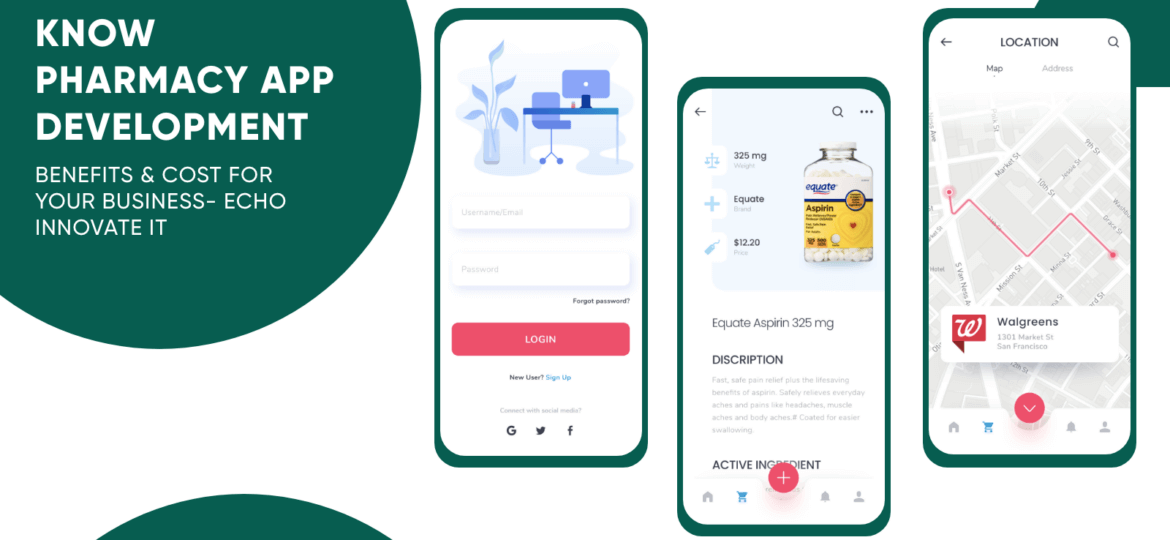
A pharmacy app in 2026 is a considerable investment to build, driven less by the number of screens than by the compliance, integrations, and clinical safety it has to get right. A simple medicine-ordering app for a single store sits near the entry level; a full platform with e-prescriptions, insurance claims, pharmacist verification, and delivery tracking runs toward the high end. Pharmacy is a regulated category, so the difference between a shopping app and a pharmacy app is largely the invisible work: HIPAA handling of patient data, prescription validation, and integrations with pharmacy management systems.
This guide covers what a pharmacy app actually involves in 2026, the features patients and pharmacists expect, the integrations and compliance involved, how long a build takes, and what moves the price. It is written for pharmacy owners, healthtech founders, and product teams weighing a build, and it closes with how EchoInnovate IT scopes and delivers these projects.
Key takeaways
- Cost is driven by compliance and integrations more than screen count; a simple app sits at the entry level and a full platform at the high end.
- The features that matter most are prescription upload and verification, refill reminders, secure payments, and delivery or pickup tracking.
- HIPAA (US) or equivalent data rules are not optional; they add security, documentation, and audit work across the whole build.
- Integrations with pharmacy management systems, e-prescription networks, and insurance are the biggest single cost and timeline factor.
- A pharmacy MVP takes about 3 to 5 months; a full multi-role platform runs 6 to 12 months.
- Start with a short scoping call so the estimate reflects your regulatory scope and existing systems, not a generic price.
What a pharmacy app does, and why build one
A pharmacy app lets patients order medicines, upload and refill prescriptions, consult a pharmacist, and track delivery or in-store pickup, while giving the pharmacy a digital storefront and a tighter link to its dispensing workflow. For an independent pharmacy or chain, it is a way to compete with large online players; for a healthtech startup, it is often the core product. Either way, the value is convenience for the patient and retention for the business, because medication is recurring by nature and an app that handles refills well earns repeat use.
The benefits fall into three groups. For patients: faster reordering, automatic refill reminders, home delivery, and the ability to speak to a pharmacist without a trip to the counter. For the pharmacy: a new sales channel, fewer phone orders to process manually, better inventory visibility, and data on what customers actually buy. For the wider health system: improved medication adherence, since reminders and easy refills measurably reduce missed doses, which is one of the most expensive problems in chronic-care management.
What separates a real pharmacy app from a generic e-commerce app is the regulated core. Prescriptions must be validated, controlled substances handled under strict rules, patient data protected under HIPAA or its regional equivalent, and pharmacist oversight built into the flow rather than bolted on. That regulated layer is where most of the engineering effort and cost live, and underestimating it is the most common reason pharmacy app budgets blow out. It is also why a general mobile app development partner with healthcare experience matters more here than in a consumer app.
How much does it cost to build a pharmacy app?
A pharmacy app is a mid-sized software investment in 2026, and where you land depends mostly on compliance scope and how many external systems you integrate. Healthcare apps sit above plain e-commerce apps of similar size because of the security, validation, and audit work the regulations require. The tiers below reflect the relative investment for a partner-built app that can safely handle real patient data and prescriptions, not a basic catalog app.
| Tier | Investment level | What you get |
|---|---|---|
| MVP | Entry-level | Medicine catalog, prescription upload, secure checkout, refill reminders, basic pharmacist review, one store. HIPAA-ready foundation. |
| Growth platform | Mid-range | Pharmacist and admin apps, delivery tracking, in-app consultations, payments, pharmacy management system integration, multi-store. |
| Scale platform | Enterprise-scale | E-prescription network, insurance and claims, controlled-substance workflows, telehealth, analytics, full audit and compliance tooling. |
Add ongoing costs on top of the build: hosting and secure infrastructure, third-party services such as SMS and payment processing, app store fees, and maintenance, which for a compliant healthcare app typically runs 15 to 20 percent of build cost per year. We do not publish a fixed EchoInnovate IT price because your regulatory scope and existing pharmacy systems change the number substantially; we give a transparent quote after a short scoping call. For how pharmacy compares to other app types, see our mobile app development cost guide.
Must-have features
A pharmacy app usually needs three connected surfaces: a patient app, a pharmacist or admin panel, and often a delivery app. The features below are the ones patients expect and regulators require. Deciding which belong in your first release is the fastest way to control the budget.
- Prescription upload and verification. Patients photograph or upload a prescription; a pharmacist reviews and approves before dispensing. This validation step is the regulatory heart of the app.
- Medicine search and reorder. A searchable catalog with dosage information, plus one-tap reorder of past medicines, which drives most repeat usage.
- Refill reminders and adherence alerts. Scheduled notifications that prompt patients before they run out, improving both retention and health outcomes.
- Secure payments and insurance. Card and wallet payments, plus insurance or claims handling where applicable, all under PCI and privacy rules.
- Delivery and pickup tracking. Real-time order status, delivery partner integration, and pickup scheduling.
- Pharmacist consultation. In-app chat or video so patients can ask about interactions and dosage, a growing expectation in 2026.
- Pharmacist and admin dashboard. Order queue, prescription review, inventory, and reporting for staff.
- Compliance and audit logging. Encrypted patient data, access controls, and a full audit trail, non-negotiable for HIPAA or equivalent.
A disciplined pharmacy MVP delivers upload, verification, reorder, secure payment, and reminders on a compliant foundation, then adds consultations, insurance, and controlled-substance workflows in later releases. We help you sequence these so the first version is both safe and shippable rather than trying to launch everything at once.
Tech stack, integrations, and compliance
Most pharmacy apps in 2026 are built cross-platform to reach iOS and Android from one codebase, commonly with Flutter or React Native for the client apps, a secure backend in Node.js or Django, and a cloud database with encryption at rest. Cross-platform keeps the build affordable without sacrificing the native device features a pharmacy app needs, such as camera capture for prescriptions and push notifications for refills. If your app leans heavily on custom clinical interfaces, our Flutter app development team often builds the patient and pharmacist apps on a shared Flutter base.
Integrations are the defining challenge. A serious pharmacy app connects to a pharmacy management or dispensing system so stock and orders stay in sync, to payment processors, to delivery logistics, and often to e-prescription networks and insurance or claims systems. In the US that can mean Surescripts-style e-prescribing and NCPDP claim standards; in other regions the equivalents differ but the pattern is the same. Each of these is a project in itself, with its own authentication, data format, and testing, and together they are the single largest driver of cost and timeline.
Compliance sits over everything. In the US, HIPAA governs how patient health information is stored, transmitted, and accessed, which means encryption, strict role-based access, audit logging, signed business-associate agreements with vendors, and documented security practices. Equivalent regimes such as GDPR in Europe add their own requirements. This work is not a feature you add at the end; it is an architecture decision made at the start, and building it in from day one is far cheaper than retrofitting it after a launch. Choosing a partner who has shipped compliant healthcare apps before is the clearest way to avoid an expensive rebuild.
How long a pharmacy app takes to build
A pharmacy app MVP typically takes 3 to 5 months to build and launch, while a full multi-role platform with e-prescriptions, insurance, and telehealth runs 6 to 12 months. Pharmacy apps take longer than comparable consumer apps because the compliance and integration work cannot be rushed, and because clinical safety demands more testing than a shopping app.
A typical timeline runs as follows. Discovery and compliance planning take two to four weeks, mapping the regulatory scope, data flows, and the systems you must integrate. UX and UI design take three to five weeks across the patient, pharmacist, and delivery surfaces. Core development runs eight to sixteen weeks, building the apps, backend, and secure data layer. Integration with pharmacy systems, payments, and any e-prescription or insurance networks adds four to eight weeks depending on their number and complexity. Testing, security review, and app store submission take three to five weeks, including the extra validation that healthcare demands. Phases overlap, so elapsed time is shorter than the sum.
The largest schedule risks are third-party dependencies and compliance sign-off, meaning the time spent waiting on access to a pharmacy management system, on a payment or insurance partner’s approval, or on a security review. These are outside pure engineering, so we plan for them early and run the compliance track in parallel with the build rather than at the end. Starting with a tightly scoped pilot, described below, surfaces these dependencies while they are still cheap to resolve.
What drives the cost up or down
Two pharmacy apps with the same catalog can differ enormously in price. Knowing the drivers lets you scope deliberately rather than react to a quote.
- Regulatory scope. A HIPAA-compliant app with controlled-substance handling costs far more than a simple over-the-counter catalog. Regulation is the single biggest multiplier.
- Integrations. Each connection to a pharmacy management system, e-prescription network, insurance, or claims platform adds significant design, coding, and testing.
- Number of user roles. Patient, pharmacist, admin, and delivery apps each add screens and logic. A patient-only app is much cheaper than a full multi-sided platform.
- Telehealth and consultations. In-app chat is moderate; live video with scheduling and clinical records is a substantial addition.
- Delivery logistics. Simple pickup is cheap; real-time delivery tracking with a rider app and routing is a project in itself.
- Insurance and claims. Automated claim submission and adjudication is one of the most complex and costly features a pharmacy app can include.
The levers that pull cost down are clear: launch patient-facing features first and defer the pharmacist and delivery apps, start with pickup before delivery, handle insurance manually at first, and limit the first release to over-the-counter and standard prescriptions before adding controlled substances. If your constraint is capacity rather than scope, our IT staff augmentation services let you add healthcare-experienced developers to your own team, and our broader software development company practice can own the compliant backend end to end.
How EchoInnovate IT builds pharmacy apps
EchoInnovate IT is an India-based custom and white-label software development company with 12 years of delivery, 50+ employees, and 500+ products shipped, most of them under our clients’ own brands. We build healthcare and pharmacy apps with compliance designed in from the first architecture decision, not bolted on at the end, and we build the patient, pharmacist, and delivery surfaces on a shared cross-platform base to keep cost and maintenance manageable.
A pharmacy engagement starts with a scoping call that maps your regulatory scope, the pharmacy and payment systems you need to integrate, and the roles your app must serve. From there a dedicated team designs the flows, builds the apps and a secure, encrypted backend, integrates your dispensing and payment systems, and runs the additional security and validation testing that healthcare requires before store submission. You get weekly demos on a working build, a transparent quote tied to your actual regulatory and integration scope, and a clear maintenance plan afterward. Because we run full mobile app development and backend practices, we can own the whole platform or slot into your existing team.
Our work carries a 5.0 rating across 6 verified client reviews on Clutch, and because we operate on an offshore model, our dedicated-team rates typically run well below onshore healthcare agencies for comparable quality and compliance rigor. If you want to test the fit before committing to a full build, the fixed-price pilot below is the lowest-risk way to start.