
Machine learning has gone from science fiction to one of the most useful tools in business. It now helps firms across many sectors work better. Good machine learning algorithms have become key to staying competitive.
Big data will shape the next wave of tech. Machine learning and AI are what unlock its value. Here is how the three connect: big data is the raw material, machine learning is the tool, and AI is the result.
Why are machine learning algorithms so important?
8 min read · Last updated: May 2026
Machine learning is a computer’s ability to learn, much like people do. It is now part of daily life. It powers self-driving cars, smarter logistics and delivery, and better elder care, among many other uses.
Machine learning works much like human learning. To give a computer that ability, it first classifies data. Then it analyzes, judges, and acts. Related: EdTech app development.
In machine learning, an algorithm finds patterns in data and predicts likely outcomes. These patterns are flexible. They update as new data comes in.
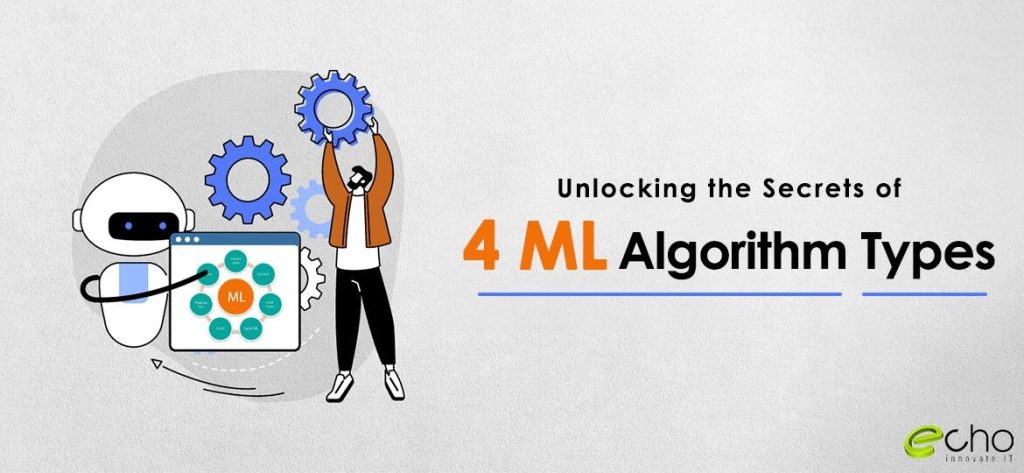
Four Types Of Machine learning algorithms
- Supervised learning,
- Unsupervised learning,
- Semi-supervised learning,
- Reinforcement learning
1. Supervised machine learning algorithms
Python’s fundamental characteristics make it a popular choice for web development.
Python is free, open-source, and easy to access. It is also very flexible. With Python, developers can build in several ways.
Python also uses dynamic typing. That means Python programs run without a separate compile step. They run at runtime. This helps web app development because it needs less code and is easier to debug.
Supervised learning is the simplest of the four types. It needs direct input from the developer. The developer labels the sample data and sets clear rules for the algorithm. Each item is labeled with the right value, so the model can learn to predict it. This relies on manual labeling, which is easy for a computer but slow for people.
Think of it as giving the machine an answer key. When tested, it answers by that key, which makes it reliable. Say you want it to tell elephants from giraffes. You show it 100 labeled photos of each. The machine learns their features from the labels. It then spots elephants and giraffes on its own, and predicts them correctly.
The major process of supervised machine learning algorithms
Classification
Classification learns from past data. You train the model to predict a yes/no result (true/false, 0/1). The algorithm sorts items into groups to predict one of two outcomes. Related: mobile app development services.
Regression
Regression finds patterns and predicts continuous values. For example, it can forecast house prices or next month’s sales.
Supervised Learning Algorithms use case
These algorithms are common in sales, retail, and stock trading. They weigh the odds and estimate likely outcomes from incoming data.
Unsupervised Machine Learning
Common uses include price prediction and trend forecasting. The model updates its estimate each time new data arrives.
Here the data has no labels. The machine sorts it by spotting features on its own. There is no manual labeling. This is easy for people but hard for the computer, so it makes more errors.
Say you use unsupervised learning on the same 100 photos. The machine must decide which are elephants and which are giraffes, and group them itself. It then uses those learned features to classify new images. But the results are not guaranteed to be right.
Unsupervised learning runs without the developer’s direct control. Supervised learning needs known past results to predict new ones. With unsupervised learning, the target results are unknown and still to be defined.
The unsupervised machine learning algorithm is:
- To explore the structure of the information
- Pattern detection
- For extracting valuable insights
Process and apply techniques of unsupervised learning algorithms
Clustering
Clustering explores data and splits it into meaningful groups. It works from patterns in the data, with no prior labels. Items are grouped by how similar they are, and set apart by how different. Related: cross-platform app development.
Dimensionality reduction
Incoming data often has a lot of noise. Dimensionality reduction removes that noise and keeps the useful signal.
3. Semi-supervised machine learning algorithms
Cleaner inputs make training faster and predictions more reliable.
Semi-supervised learning sits between supervised and unsupervised. It blends both into one approach. Only a small part of the data is labeled. The computer finds features in that labeled data, then classifies the rest.
This is the most common method, and it can improve accuracy. Say you have 100 photos, with ten elephants and ten giraffes labeled. The machine sorts the rest using those ten. Because it has a base to work from, results are usually more accurate than unsupervised learning.
Semi-supervised algorithms and their works
A semi-supervised algorithm shapes its rules from a small set of labeled data.
Because the labels are limited, the model starts partly trained. It then labels the unlabeled data. The output is pseudo-labeled data. Related: hire cross-platform developers.
Finally, the labeled and pseudo-labeled data are combined. This creates one algorithm that mixes the strengths of supervised and unsupervised learning.
Use case of semi-supervised algorithms
Semi-supervised learning is used in law, healthcare, and web content classification, plus image and speech analysis. For web content, crawlers and aggregation systems use it. In each case, it reads content and sorts it using many labels. Even so, it usually needs some human review.
In image and speech analysis, the algorithm labels data to build a working model. It can produce clear transcription from a sample set. An example is an MRI or CT scan. A small set of good scans can train a model that spots the target.
4. Reinforcement machine learning
Exploration and exploitation are part of reinforcement learning. The idea is simple: the model acts, sees the result, and uses that result in its next action. It is a loop.
The machine learns from its environment. It takes actions that raise the reward or lower the risk. There are no labels. Instead, feedback tells it which steps are right or wrong. Over time it adjusts until it gets the right result.
Use case of a reinforcement learning algorithm
Reinforcement learning suits cases with limited or patchy data. Here the rules form from the model’s own interaction with the data and the task.
This type is common in video games. It lets the game’s AI react to the player in a flexible way, which makes for better challenges. For example, collision detection for moving vehicles uses this kind of algorithm. Related: custom software development.
Reinforcement learning also fits marketing and ad tech. By adapting to user behavior and context, it makes retargeting more flexible and better at driving conversions.
Importance of algorithm
In short, a machine learning model finds patterns in data and predicts outcomes. It keeps adapting as new data comes in.
The bottom line – Types of Machine Algorithms
As you can see, each type of machine learning solves a different kind of problem. Combining them creates something powerful. It can handle many tasks and pull useful insights from many kinds of data.
Frequently Asked Questions
What algorithms are commonly used in supervised learning?
Classification algorithms:
Logistic Regression
Decision Trees and Random Forests
Support Vector Machines (SVM)
Naïve Bayes
k‑Nearest Neighbors (k‑NN)
Neural Networks
Regression algorithms:
Linear Regression, Ridge, Lasso
Support Vector Regression (SVR)
Tree-based regression and Gradient Boosting Machines (e.g., XGBoost, CatBoost)
What techniques fall under unsupervised learning?
Common methods include:
Clustering: k‑Means, Hierarchical Clustering, DBSCAN, Gaussian Mixture Models
Dimensionality Reduction: Principal Component Analysis (PCA), t‑SNE, ICA, UMAP
Association Rule Learning: Apriori, Eclat
Anomaly Detection: Isolation Forest, Local Outlier Factor
Latent Variable Models: Expectation-Maximization (EM), matrix decomposition like SVD or NMF
What is ensemble learning and how does it relate?
Ensemble learning combines multiple models to improve performance:
Bagging (e.g. Random Forest) reduces variance by averaging diverse models
Boosting (e.g. AdaBoost, XGBoost, CatBoost) focuses on correcting errors in successive learners
Stacking blends outputs of different algorithm types into a final meta-model
What are the main categories of machine learning?
There are three primary learning paradigms:
Supervised Learning – using labeled data for prediction tasks (classification/regression)
Unsupervised Learning – discovering hidden structures from unlabeled data
Reinforcement Learning – training agents to maximize rewards through interaction with an environment
Build the e-learning platform parents actually trust.
Live classes, recorded courses, AI tutors, gamification, progress tracking, parent dashboards, multi-language, SCORM/LTI — we’ve shipped 25+ EdTech platforms used by 2M+ students. We obsess over engagement metrics most agencies ignore: completion rates, drop-off points, retention curves. Bring us your curriculum and audience — we’ll architect a platform that beats Coursera at your niche.