
Today, AI can do almost anything. It suggests new ideas, generates content, draws pictures, and even makes music. Generative AI lets users create new content from many kinds of input. These models can take in and produce text, photos, sounds, animation, 3D models, and other data. Their foundation models let organizations run many tasks at once. Popular examples include ChatGPT, Bard, and Artbreeder.
AI is changing fast, and that affects human creativity. Human creativity is driven by conceptual thinking, emotional expression, and artistic vision. So many people fear a loss of originality, repetitive content, and too much reliance on generative AI tools. That is also why we keep hearing about people losing jobs to AI. For many industries, AI can now do traditional tasks in minutes.
It can write, design, and create graphics for companies. This affects the work of artists, writers, musicians, and graphic designers. So is generative AI a positive or a negative force? If it is negative, how can creative professionals protect their roles in the age of AI digital marketing? And if it is positive, how can they find balance and work with it?
Generative AI And Its Benefits
9 min read · Last updated: May 2026
Generative AI is one of the newest tools for creative industries. It is a subset of artificial intelligence (AI) that focuses on creation, not just data processing. It shows how quickly technology keeps moving forward. Because generative AI is trained on huge amounts of data, it can read what a user types and return the result they want. In this way, it acts as a virtual assistant. Related: on-demand app development.
To build a generative AI, researchers first collect a huge amount of data to teach the model. They then clean this data and prepare it for machine learning algorithms. This can include tokenization, vectorization, and data augmentation. Next, they design the model architecture. It uses neural networks such as generators and discriminators.
The chosen model is trained on the prepared dataset. This means feeding it a large amount of data and adjusting its internal parameters. The goal is to shrink the gap between the generated output and the real data. The trained model is then tested on a separate dataset. Here are some real benefits of generative AI:
Innovation and Automation:
Content generation is one of the most common uses of generative AI. Marketing teams spend a lot of time creating fresh content. This includes marketing copy, blog posts, social media posts, and graphic design.
AI can suggest original ideas, explore unusual solutions, and push creative limits. This gives people fresh points of view.
AI tools can help artists, writers, and designers get past creative blocks. They propose new techniques, produce variations, and suggest fresh directions.
Provide Personalized Experiences:
AI can create personalized content, product suggestions, and marketing messages. This improves the user experience and raises customer engagement.
AI improves business processes by personalizing customer interactions. It can learn about your firm and its offerings. Paired with customer data, generative AI can help you build tailored experiences.
Generative AI can create products and services shaped around individual needs and preferences. This raises customer satisfaction. Related: mobile app development services.
Reduces Human Workload:
AI helps streamline business processes. Find tasks you can automate, then use AI to generate the data. This lowers your team’s workload and helps them get more done each day. Many tools also let you enter text reports into an AI text generator and get quick summaries.
Improves Cybersecurity:
Generative AI can help firms improve cybersecurity. Companies must review huge amounts of data to spot threats, and AI can assist with that. It analyzes data and finds activity patterns that stray from the norm. If something looks wrong, AI can alert your team to a possible issue and often address it in real time.
Analyze Latest Market Trends:
AI can help you by reviewing large amounts of data. AI models use deep learning to spot market trends and weigh other market factors. This lets businesses make decisions with more confidence and less risk.
Once you see how customer preferences are changing, use AI to generate suggestions. Enter the new problems customers face, along with possible fixes and upgrades to your current items. This can make them more appealing in the new market.
AI Creativity vs Human Creativity: Understanding the Clear Differences
AI can process huge amounts of data and give advanced results. Yet human creativity is driven by emotions and experiences that no machine can copy. Understanding both helps us compare them and see which one will lead.
AI lacks emotional intelligence, and humans cannot create content as fast as AI. Still, humans can think outside the box. We form ideas from intuition and personal experience, which drives creativity and progress. Let us compare the two side by side.
| Factors | AI Creativity | Human Creativity |
|---|---|---|
| Source | Algorithms, data, and patterns | Emotions, experiences, imagination, intuition |
| Nature | Rule-based and algorithmic | Intuitive, spontaneous, subjective |
| Output | Novel combinations and variations | Original ideas, unique perspectives, emotional expression |
| Strengths | Speed, efficiency, data analysis with great possibilities | Emotional depth, empathy, critical thinking, problem solving, and cultural awareness |
| Limitations | Lack of genuine emotion, reliance on existing data, potential for bias, difficulty with abstract concepts | Limited by physical and mental restrictions, prone to prejudices, vulnerable to emotional barriers |
| Role | Tool for exploration, idea generation, automation | Driver of innovation, expression of personality, and cultural growth |
How Generative AI Impacts Creativity?
As we noted at the start of this blog, generative AI is a debated topic. Its impact on humans and creative work is hard to ignore. Let’s look at some pros and cons of generative AI for human creativity:
As we noted at the start of this blog, generative AI is a debated topic. Its impact on humans and creative work is hard to ignore. Let’s look at some pros and cons of generative AI for human creativity: Related: cross-platform app development.
Pros of Generative AI
- Perform tasks that need human intelligence, such as problem-solving, language comprehension, and decision-making.
- AI tools can help artists, writers, and designers get past creative blocks. They propose new techniques, produce variations, and suggest fresh directions.
- AI tools can help artists, writers, and designers get past creative blocks. They propose new techniques, produce variations, and suggest fresh directions.
- AI can help people with disabilities. It creates other ways to communicate, such as text-to-speech and image description.
- AI can speed up content creation. This lets organizations produce high-quality material more quickly and efficiently.
Cons of Generative AI
- AI lacks human emotional intelligence. That intelligence aids decisions that need empathy and intuition.
- AI models are trained on large sets of existing work. This can lead to over-reliance on set patterns and styles. As a result, it may limit originality and the search for new ideas.
- AI cannot feel emotions or form human connections, which often spark creativity.
- AI models can reflect and amplify biases in their training data. This may produce unfair or discriminatory outputs.
- As AI advances, there may be concerns about job loss among artists, musicians, and other creative people.
How AI And Human Creativity Can Work Together
Even with the AI boom, human ingenuity remains a vital asset. Machines are great at analyzing large amounts of data and spotting patterns. But they cannot produce truly original ideas, think outside the box, or add emotional depth and personal meaning.
Forward-thinking leaders should not treat AI as a threat to human talent. Instead, they should look for ways to use it to support and expand human abilities.
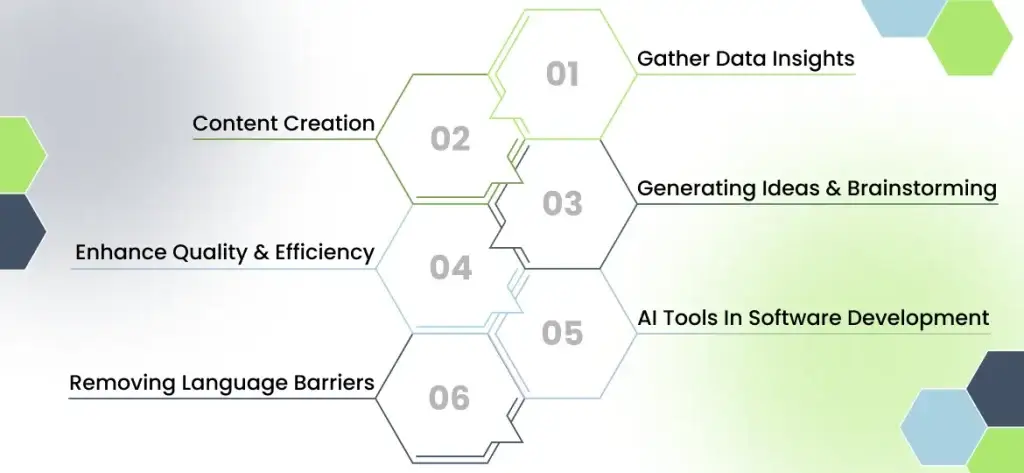
Human-AI collaboration is reshaping industries and opening new possibilities. Let’s look at how AI and human creativity can work together and find balance:
Content Creation
In content creation, AI can help build outlines, fact-check, and suggest edits. This lets creators produce high-quality material more efficiently. Contrary to popular belief, human-AI collaboration boosts innovation across many fields.
AI systems can produce ideas, offer changes, and create artistic content. But the human touch adds the final layer of creativity, intuition, and emotional connection.
Gather Data Insights
AI systems can analyze large amounts of user data. They uncover new trends, customer preferences, and unmet needs. With these insights, human designers can focus their talents on unique solutions. Those solutions can meet the deeper wants and goals of the target audience.
Human creators can use AI’s data-driven insight to make better decisions and iterate faster. This helps them reach solutions that are both efficient and emotionally resonant. Related: hire cross-platform developers.
Generating Ideas & Brainstorming
Traditional brainstorming relies on people to produce ideas, but AI can help and improve the process. AI-powered tools can help users explore different views, generate fresh ideas, and predict likely outcomes. By pairing human creativity with AI’s analytical power, teams can innovate more and reach strong new solutions.
For writers, artists, and musicians, working with AI can open new paths for creative exploration. It can surface thoughts and concepts they might otherwise miss. Used as a creative collaborator, AI can help humans push the limits of their imagination. Together they can create work beyond what one person could reach alone.
Enhance Quality & Efficiency
AI systems can act as smart assistants. They offer people real-time information, analysis, and recommendations. This helps people make better decisions and work more effectively. AI can help build content outlines, fact-check, and suggest edits, so authors produce high-quality material faster.
AI Tools In Software Development
AI-powered tools can automate repetitive tasks such as code generation, testing, and debugging. This lets developers focus on harder, more creative parts of the work.
AI tools can review code for potential flaws, security risks, and performance issues. This helps developers find and fix problems early in the development cycle. AI can also help make sure code follows best practices, so it is easier to maintain and upgrade.
Removing Language Barriers
AI-powered language translation systems are still being developed. At first, these systems produced grammatically correct translations but missed nuance and context.
Human linguists and translators added their expertise. They reviewed and improved the output of the AI algorithms.
This steady loop of feedback and improvement has made translation systems more accurate and more relevant to context. Related: custom software development.
Conclusion
To wrap up this blog on generative AI and human creativity, most of us agree on one thing. We need a space where both can work together. AI consultants can build campaigns that connect deeply with the target audience. They use AI for data-driven insight and automation, and human creativity for emotional connection, cultural sensitivity, and innovation.
In the end, the future of work will belong to those who can use AI well. They must also value human creativity, empathy, and imagination. This balance lets us shape a more inventive, rewarding, and purpose-driven future of work.
Want to bring an AI strategy to your team and grow your organization with generative AI? Hire our team and see how our AI consulting services can help you find new opportunities!
Frequently Asked Questions
Is generative AI replacing human creativity in 2026?
Augmenting more than replacing. AI handles routine creative work (initial drafts, variations, technical execution) faster than humans. Senior creatives focus on strategy, taste, and high-judgment decisions AI can’t make reliably. The pattern: junior creative work has compressed (faster, cheaper, AI-assisted), senior creative work has expanded (higher leverage on strategic decisions). Total creative employment in 2026 is roughly stable; the role mix has shifted.
What can generative AI do better than humans?
Generative AI in 2026 outperforms humans at: (1) Speed (10-100× faster for routine tasks). (2) Volume (generating 100 variations vs. 5). (3) Translation and adaptation (multilingual content, format conversion). (4) Pattern matching from large datasets (writing in established styles, summarizing patterns). (5) Cost efficiency for routine work. Humans still win on novel ideas, taste, contextual judgment, and emotional nuance.
What can humans do better than AI?
Where humans still clearly lead: (1) Truly original ideas — AI extrapolates from training data; humans create genuinely new patterns. (2) Taste and judgment — knowing which option among many is “the right one” for a specific audience or moment. (3) Emotional truth — writing/art that moves people because the creator has lived experience. (4) Cultural and contextual nuance. (5) Strategic vision — what to build, why it matters, how to position it.
How is generative AI changing creative industries?
Specific shifts in 2026: (1) Stock photography mostly replaced by AI image generation (Midjourney, DALL-E). (2) Initial copywriting drafts increasingly AI-generated, refined by humans. (3) Code generation dramatically AI-augmented (Copilot, Cursor used by most professional developers). (4) Music production increasingly AI-assisted for backing tracks and stems. (5) Video editing with AI for color grading, transcription, and rough cuts.
Should creative professionals worry about AI replacing them?
The realistic assessment in 2026: Junior creative roles face significant disruption — much routine work is now AI-handled. Senior creative roles are growing more leveraged — one senior creative + AI tools produces output that previously required a team. Strategy and taste-driven roles are increasingly valuable. Creatives who use AI as a tool typically win; those who refuse to learn it lose ground. The shift is similar to past automation — disruptive in the short term, productivity-multiplying long term.
Launch a Streaming or On-Demand App
Build a Netflix, ShowBox, or Spotify-class streaming experience. Get DRM, CDN integration, a recommendation engine, and monetization, all native.
